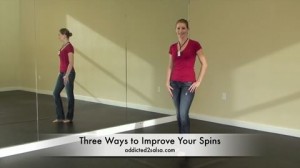
How to Improve Your Salsa Spins
- Episode : 45
- Published: Apr 21 2009
- Difficulty: Intermediate
If your salsa spins feel rushed, heavy, or inconsistent, the problem is usually not "more power." Most dancers lose control before the spin even starts. The real work happens in posture, prep, timing, and how well you stay centered over your standing foot.
That is why this lesson still matters. It focuses on three foundations that show up in almost every strong salsa spinner: frame, prep, and spotting. Those ideas sound basic, but they connect to nearly every other turning skill, including balance, clean exits, and multiple spins.
Why salsa spins usually break down
When spins go wrong, dancers usually make one of these mistakes:
- the shoulders rise and the neck tightens,
- the prep comes late and throws the body off axis,
- the dancer leans too far forward or back,
- the free arm flies open and pulls the turn off center,
- the feet push too hard into the floor instead of staying grounded and quick.
In other words, spinning is less about force and more about organization. Good salsa turns feel easier because the body is stacked and ready before the rotation starts.
The three main priorities
1. Build a stable frame first
Frame is not just "hold your arms up." In salsa spinning, frame means keeping the upper body organized so the rotation has a clean structure. A straight but not stiff back, relaxed shoulders, engaged core, and soft knees all help keep your center of gravity from drifting.
What that should feel like:
- chest lifted without arching the lower back,
- chin level instead of dropping toward the floor,
- elbows alive instead of collapsing behind the rib cage,
- core engaged enough to keep the ribs and hips connected.
If your frame falls apart, spotting and prep will not save the turn. This is why many dancers can do one clean spin when they focus, but lose control as soon as they try doubles. The body no longer stays organized through the extra rotation.
2. Make the prep earlier and cleaner
Prep is the launch point of the spin. In salsa, a good prep does not feel exaggerated or dramatic. It feels early, balanced, and clear.
The most common error is winding up too much or too late. That creates a jerky start and often sends the dancer traveling sideways instead of turning in place. A better prep keeps the weight grounded, the standing leg ready, and the body centered before the release.
For both solo and partner turns, think about:
- being fully over the supporting foot before rotation,
- keeping the knees soft rather than locked,
- creating direction with the body instead of whipping the arms,
- letting the first turn start cleanly so later rotations have something solid to build on.
Strong multiple spins often depend on one excellent first spin. If the first rotation is crooked, the rest of the turn usually becomes recovery mode.
3. Use spotting to stay oriented
Spotting helps you keep your balance, reduce dizziness, and finish facing the direction you intended. It does not create the spin by itself, but it helps organize the head and upper body so the turn feels more deliberate.
The basic idea is simple: hold your eyes on a target as long as possible, then whip the head around and find that target again. In salsa, that target may be your partner, the mirror, or a point on the wall.
Spotting works best when:
- the rest of your posture is already stable,
- the head snaps cleanly instead of dragging,
- the shoulders stay relaxed,
- you re-focus quickly instead of staring downward after the turn.
If you practice spotting slowly and consistently, your turns usually start feeling calmer almost immediately.
The footwork detail many dancers ignore
A lot of spin problems start in the feet. If the standing foot is flat and heavy, or if the floor grip is too sticky, the body has to fight for every turn.
For cleaner salsa spins, aim to stay light and centered over the ball of the foot without gripping the floor. The foot should feel active, not tense. Your knees stay soft so the body can absorb and redirect motion instead of bouncing out of it.
This is also why practice conditions matter. Spinning on a rough floor with sticky shoes can teach bad habits. If your technique feels worse than usual, check the surface before assuming your mechanics disappeared.
How to practice spins without reinforcing bad habits
Do not start with triples. Start with repeatable singles.
Try this progression:
- Practice right and left single spins in place.
- Check whether you finish on balance without hopping.
- Add spotting while keeping the shoulders relaxed.
- Add a clean prep and repeat until it feels automatic.
- Only then test doubles.
A useful training goal is not "more spins." It is "same finish every time." If you can land a single spin on balance ten times in a row, your doubles will improve much faster than if you keep forcing extra rotations.
What leaders and followers should each notice
Followers should pay attention to center, core connection, and how quickly they can collect themselves after a turn. Leaders should pay attention to how cleanly they set up the turn and whether they are supporting the spin or accidentally disturbing it.
In partnerwork, rough hands and excessive force often destroy spinning technique. A good lead gives direction and timing, then allows the turn to happen. A strong follow maintains her own axis instead of depending on the leader to hold her up.
What to look for in this lesson
As you watch the video, notice how the improvement points are not about tricks. They are about cleaner fundamentals:
- a stronger dance frame,
- a more prepared body position before takeoff,
- a clearer visual target during rotation.
Those are exactly the corrections that make salsa spins smoother in social dancing, not just in practice drills.
If you want better turns, train the setup as seriously as the spin itself. Cleaner salsa spins come from better mechanics, not more force.
Pocket Salsa App
Practice salsa between classes with step-by-step lessons, timing drills, and partnerwork training.


Also available on Android.

Related Salsa Dance Videos